
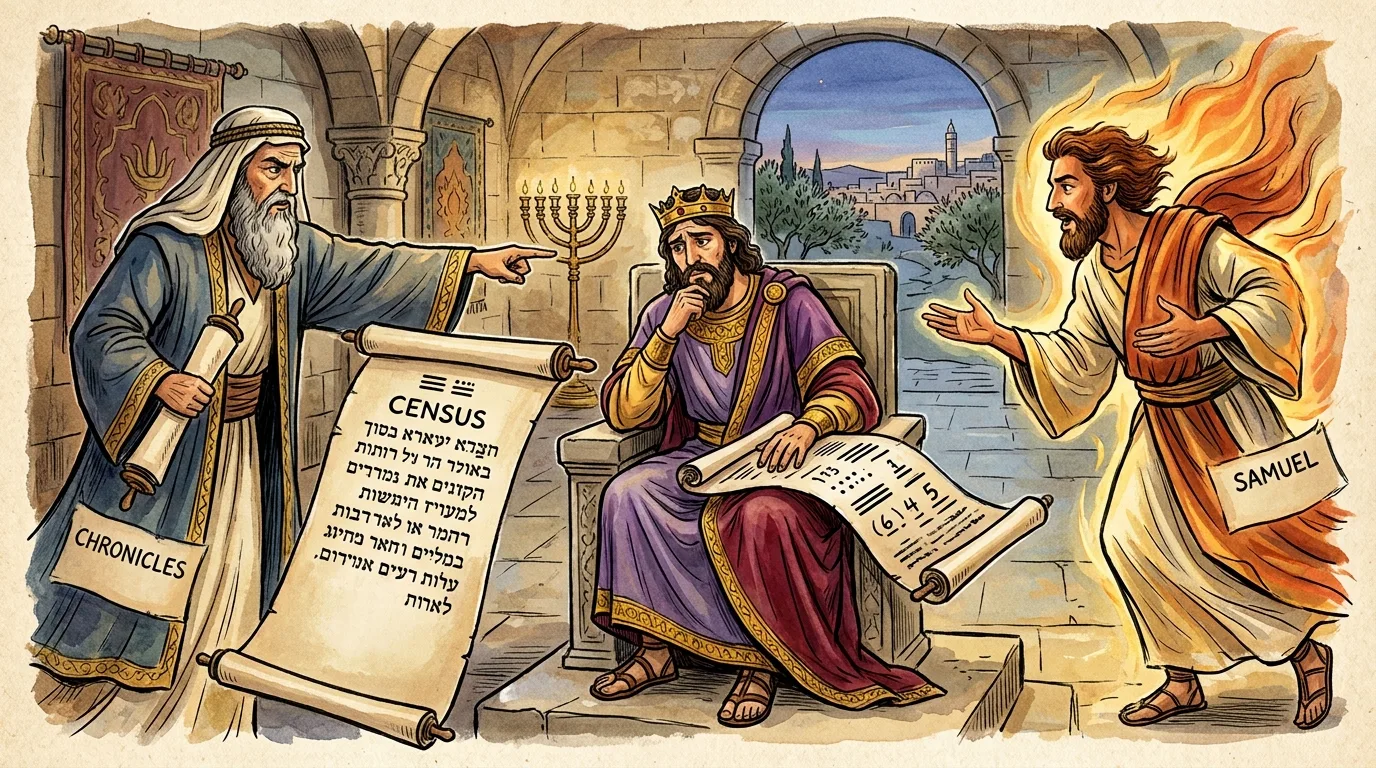
The Bible tells the story of King David counting his fighting men twice, and both times it says someone put the idea in his head. The first version names the LORD. The second, written centuries later and copied from the first, names Satan. One author is correcting the other, and the correction tells you more about the Bible than either story does.
Same Story, Same Verb, Different Instigator
Here is Samuel: “And again the anger of the LORD was kindled against Israel, and he moved David against them to say, Go, number Israel and Judah" (2 Samuel 24:1, KJV).
Here is Chronicles: “And Satan stood up against Israel, and provoked David to number Israel" (1 Chronicles 21:1, KJV).
The KJV uses two English verbs, “moved" and “provoked," but the Hebrew uses one. Both verses use sut, which means to incite or stir someone up, in the same form. The object is David in both. The target is Israel in both. Only the subject changes. Where Samuel has the LORD, Chronicles has satan.
What follows is the same story in both books. Joab, David's general, objects that the king has no reason to do this. David overrules him. The count takes nine months and twenty days (2 Samuel 24:8). Then David's conscience strikes him, and he confesses: “I have sinned greatly in that I have done" (24:10). The prophet Gad brings him three punishments to choose from, and David says he would rather fall into the hand of the LORD than into the hand of man. A plague follows, and seventy thousand Israelites die (24:15; 1 Chronicles 21:14). The destroying angel stops at a threshing floor outside Jerusalem, David buys the floor and builds an altar there, and the plague ends.
Both books treat the census as a sin. David says so, Joab says so, and seventy thousand people die for it. The question is who started it.
The Older Book Has God Doing It
Samuel was written first, and its account is blunt. God is angry at Israel. The text doesn't say why. The word “again" points back to the famine of 2 Samuel 21, when God punished Israel for Saul's massacre of the Gibeonites, but no new offense is named here. God, angry, moves David to do something that God will then punish by killing seventy thousand people who had no say in it.
That's a hard verse, and the author of Samuel didn't think it needed softening. It fits the older layers of the Hebrew Bible, where the LORD routinely does what later readers would assign to a devil. “An evil spirit from the LORD troubled" Saul (1 Samuel 16:14). In 1 Kings 22 the LORD asks his heavenly court who will lure King Ahab to his death, and a spirit volunteers to be “a lying spirit in the mouth of all his prophets" (22:22). The LORD hardens Pharaoh's heart and then punishes Egypt for Pharaoh's stubbornness. Amos asks, expecting the answer no, “shall there be evil in a city, and the LORD hath not done it?" (Amos 3:6). And in Isaiah, God says it outright: “I make peace, and create evil" (Isaiah 45:7).
In that world there's no rival power to blame. If it happened, God did it. Samuel's census story is an honest expression of that theology.
The Chronicler Rewrote His Source, and Not Only Here
Chronicles is not an independent witness. Its author, whom scholars call the Chronicler, wrote in the Persian or early Hellenistic period, probably in the fourth century BCE, and used Samuel and Kings as his main source. Long stretches of Chronicles copy Samuel nearly word for word, and the stretches that don't are where you learn what the Chronicler cared about. Sara Japhet, whose commentary on Chronicles is one of the standard works on the book, reads it as a deliberate retelling of that earlier history, reshaped by the Chronicler's own theology.1Japhet's commentary treats Chronicles as a rewriting of Samuel and Kings and compares the parallel passages throughout, including 2 Samuel 24 and 1 Chronicles 21.
You can watch the reshaping all through chapter 21. Samuel counts 800,000 men in Israel and 500,000 in Judah (2 Samuel 24:9); Chronicles counts 1,100,000 and 470,000 (1 Chronicles 21:5). Chronicles adds that Joab left Levi and Benjamin out of the count, “for the king's word was abominable to Joab" (21:6). Gad's first option is seven years of famine in Samuel (24:13) and three in Chronicles (21:12). David pays fifty shekels of silver for the threshing floor and the oxen in Samuel (24:24). In Chronicles he pays six hundred shekels of gold for “the place" (21:25). Chronicles then adds fire from heaven to consume David's offering (21:26) and has David declare the spot the site of the future temple (22:1).
Some of those differences are probably copying errors. The famine figure is a good candidate, since the ancient Greek translation of Samuel also reads three years. Others aren't. A twelvefold price in a costlier metal and a fire from heaven are what you'd write if you wanted the temple's foundation to look more glorious. And swapping God for satan in the first verse is what you'd write if your source said something about God you couldn't accept.
That's the plainest reading of the change. The Chronicler was copying a story in which God provokes a sin and then punishes a nation for it. He couldn't leave it that way. So he kept the verb, the object, and the target, and replaced the one who acts.
Satan Wasn't the Devil Yet
The word the Chronicler chose matters. In Hebrew, satan is a common noun meaning adversary or accuser, and it often refers to a human being. The Philistine commanders worry that David will turn into a satan against them in battle (1 Samuel 29:4). God raises up Hadad the Edomite as a satan against Solomon (1 Kings 11:14). Even the angel of the LORD stands in Balaam's road “for an adversary against him" (Numbers 22:22), and the Hebrew there is satan.
Only a few passages give the word a heavenly character. In Job 1–2 and Zechariah 3 a figure called ha-satan, “the adversary," with the definite article, appears among the beings around God's throne, acting as an accuser. Peggy Day's study of every supernatural occurrence concludes that none of them is the Devil of later Judaism and Christianity. Elaine Pagels makes the same point in tracing how that Devil developed: in the Hebrew Bible the satan works for God, not against him.2Day examines the four passages where a superhuman satan appears and finds no evil cosmic opponent of God in any of them. Pagels traces the figure from the Hebrew Bible's obstructing agent to the New Testament's Prince of Darkness.
In 1 Chronicles 21:1 the word has no article, which is why some scholars translate it “an adversary" instead of “Satan." Japhet argues for a common noun here, perhaps a human official. Paul Evans, writing in Biblica, argues instead for a heavenly intermediary carrying out the LORD's will.3Japhet reads the anarthrous satan of 1 Chronicles 21:1 as a common noun. Evans reviews her view and others and argues for a divine intermediary. They disagree about who the adversary is. They agree the Chronicler wasn't reaching for the cosmic enemy of the New Testament. He was reaching for someone who wasn't God.
Job shows where he could have found that someone. After the satan has destroyed Job's children and property, God says to him, “thou movedst me against him, to destroy him without cause" (Job 2:3). The verb is sut again. In Job, the adversary incites God. In Chronicles, the adversary incites David. The Chronicler had a figure in his tradition whose role was to provoke, and he moved that figure into the sentence where God used to be.
“God Permitted It" Is a Third Story
The standard conservative answer is that both books are right. Norman Geisler and Thomas Howe, in their popular handbook of Bible difficulties, put it this way: Satan incited David directly, and God permitted him to, so each author names a different link in the same chain. They compare it to Job, where God lets the satan strike and both are at work for different ends.4Geisler and Howe answer that both statements are true: Satan was the immediate cause and God permitted it, with Satan's purpose destructive and God's redemptive.
This deserves a fair hearing. It's the answer most believers have been given, and it rests on something real. The Bible does show God working through intermediaries, and Job is the clearest case.
But look at what it does to Samuel. Samuel doesn't say God permitted anything. It says God's anger burned against Israel and he incited David against them. The anger is God's, the verb is active, and the people harmed are the people God is angry with. To turn that into permission you have to reread the sentence as a statement about a third party it never mentions. Some defenders go further and read the “he" as an unnamed someone, or as the anger itself. The Chronicler is the best evidence against all of these. He's the earliest reader of 2 Samuel 24:1 whose interpretation survives, and he plainly read it as God doing the inciting. If he hadn't, he wouldn't have needed to change it.
The appeal to Job proves too much. Job does show God and the satan both at work, and it shows them openly, in a scene set in heaven where they talk to each other. Neither census account has a scene like that. Samuel has God alone. Chronicles has the adversary alone. The harmonization combines the two into a version neither author wrote. That isn't reconciling two texts. It's writing a third.
And the permission answer doesn't remove the problem the Chronicler was trying to solve. If God, angry at Israel, let an adversary push David into a sin so that he could kill seventy thousand people for it, God is still the one who wanted it done. The Letter of James would later insist that God tempts no one (James 1:13). The author of Samuel hadn't heard that rule.
You Can Watch the Bible Change Its Mind
The interesting thing here isn't that two verses disagree. It's that you can see the disagreement happen. We have the source, we have the copy, and we can point to the word that changed. A later author read an older sacred text, found something in it about God he couldn't accept, and fixed it.
That's how the Devil got his job. The Satan of the Gospels, the tempter in the wilderness and “the prince of this world" (John 12:31), comes after this point and grows partly out of moves like this one. As Israel's God came to be thought of as wholly good, the acts once credited to him needed somewhere else to go.
The Chronicler didn't discover that God was innocent. He decided it.
If you grew up being told that the Bible speaks with one voice, this passage is worth sitting with, because its own authors didn't think so. The Chronicler had Samuel in front of him and didn't harmonize it. He contradicted it on purpose, because his idea of God had moved past the one he'd inherited. You're allowed to do what he did. You only have to admit what he wouldn't: that it means the older text was wrong.