
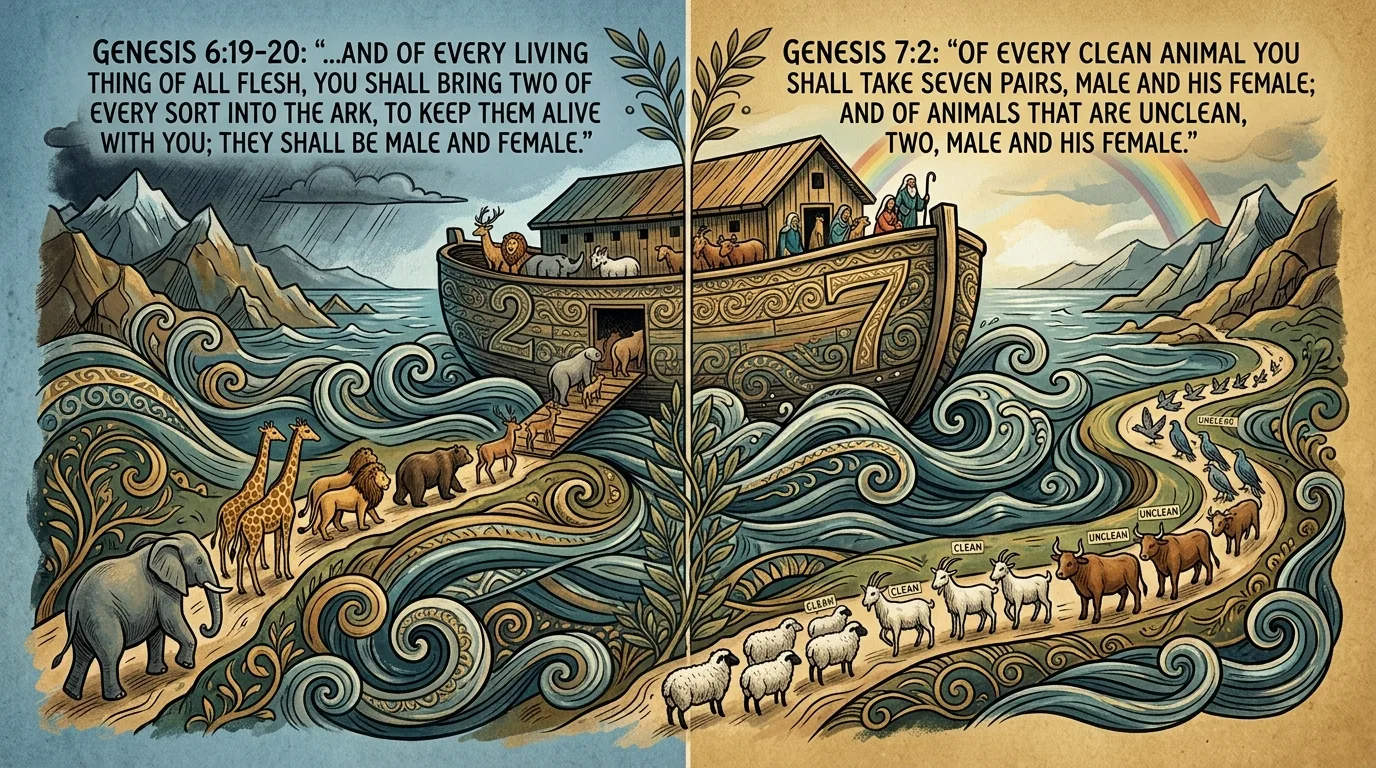
Genesis 6:19 has God tell Noah to bring two of every living thing onto the ark. Genesis 7:2, nine verses later, has God tell Noah to bring seven of every clean animal and two of every unclean one. Most people who grew up with this story never noticed, because the version they got came with a coloring book, and coloring books have the giraffes walking up the ramp two by two.
The Two Commands Sit Nine Verses Apart
The first instruction closes chapter 6. “And of every living thing of all flesh, two of every sort shalt thou bring into the ark, to keep them alive with thee; they shall be male and female" (6:19, KJV). The next verse repeats it for birds, cattle, and creeping things. Then the compliance report: “Thus did Noah; according to all that God commanded him, so did he" (6:22).
That is a complete instruction followed by a complete obedience. The story could go anywhere from there.
Instead chapter 7 opens and the instruction starts over. “Of every clean beast thou shalt take to thee by sevens, the male and his female: and of beasts that are not clean by two, the male and his female" (7:2). And again the obedience: “And Noah did according unto all that the LORD commanded him" (7:5).
Two commands, two obediences, different numbers. There is something else in those four verses that English hides. In 6:19–22 the speaker is Elohim, God. In 7:1–5 the speaker is YHWH, which the KJV prints as LORD in small capitals. The name switches at exactly the point the number switches.
It Isn't Only the Animals
Once you are looking for it, the flood narrative keeps doing this.
How long did the water rise? “Forty days and forty nights" (7:12). Also: “And the waters prevailed upon the earth an hundred and fifty days" (7:24).
What caused it? Rain, in 7:4 and 7:12. But 7:11 describes something much larger: all the fountains of the great deep broken up, and the windows of heaven opened. That is not weather. That is the dome of Genesis 1 giving way, and the water it was built to hold back arriving from above and below at once.
When did it start? Seven days after Noah boarded (7:10). Also the same day he boarded (7:11–13).
And afterward, Noah sends out a raven (8:7). Noah also sends out a dove, three times, at seven-day intervals (8:8–12).
Which bird? Both. Which flood? Both.
Pull the Two Threads and Both Stories Stand Up
Here is the part that turns a list of annoyances into an argument.
Sort the verses by which divine name they use, then look at what happens to everything else. The Elohim verses give you two of every animal, the fountains of the deep, a hundred and fifty days, dates fixed to the month and day of Noah's six hundredth year, a raven, and a covenant sealed with a rainbow. The YHWH verses give you seven clean animals and two unclean, forty days of rain, a week of waiting, a dove sent out three times, and an altar at the end.
Neither pile is missing a piece. Each one runs start to finish: divine decision, warning, boarding, flood, recession, landing, exit.1Friedman prints the flood story with the two strands typographically separated, so the reader can see each one run continuously. He also notes that the Priestly source defers all legitimate sacrifice until the Tabernacle is built, which is why its Noah needs no spare animals.
That is a strange result to get by accident. Take any story that was composed as one story, sort its sentences by some unrelated feature, and you get two piles of fragments. You do not get two working narratives. This is why the flood has been the standard demonstration of source criticism for two and a half centuries. Joel Baden, who defends the documentary hypothesis in a considerably more disciplined form than Wellhausen left it in, still opens with this passage, because nothing else in the Torah separates this cleanly.2The source division of the flood goes back to Jean Astruc in 1753 and was formalized by Wellhausen in the 1880s. Baden's 2012 restatement keeps the flood as its opening case study while discarding much of the nineteenth-century apparatus around it.
Why One Noah Needed Extra Sheep
The two strands do not merely differ. They differ in ways that serve their own theology.
The YHWH story ends at an altar. “And Noah builded an altar unto the LORD; and took of every clean beast, and of every clean fowl, and offered burnt offerings on the altar" (8:20). If Noah had boarded with exactly one breeding pair per species, that sacrifice is an extinction event. He needs spares, and his version of the command hands him spares. Seven of the clean animals, and clean is precisely the category you are permitted to burn.
The Elohim story contains no sacrifice at all. It does not need one, and within the Priestly scheme it could not have one, because legitimate offering does not begin until the Tabernacle stands at the end of Exodus. Two per species is exactly right for a story in which nothing is killed at the end.
So the number is not a slip. In each story the number is load-bearing. The seven pairs are not a detail one author forgot to reconcile with another. They are a detail that author required.
The Harmonizing Moves, and Why They Don't Work
The defenses are real and deserve a fair hearing.
Umberto Cassuto spent his career arguing against the documentary hypothesis and was nobody's fundamentalist. He read 7:2 as a second, more specific command: the general order stands, and Noah now receives an additional instruction covering the clean animals he will need later. Gleason Archer runs a version of the same line in the Encyclopedia of Bible Difficulties. General first, specific after, an ordinary habit of Hebrew narrative.3Cassuto's case against source division is laid out across his 1941 lectures and his Genesis commentary. He argues that the repetitions reflect Hebrew narrative convention rather than seams, and that the critics have mistaken style for stitching.
It is a reasonable reading of those two verses on their own. It collapses on the third one.
Genesis 7:8–9 reports what Noah actually did:
Of clean beasts, and of beasts that are not clean, and of fowls, and of every thing that creepeth upon the earth, There went in two and two unto Noah into the ark, the male and the female, as God had commanded Noah.
Clean animals, named as such, going in two by two. Verse 15 says it again. Verse 16 says it again. If 7:2 were a refinement of an earlier order, the execution report would carry the refinement. It carries the other number, three times over.
There is also a translation wrinkle, and it does not help the harmonizer. The Hebrew of 7:2 is shiv'ah shiv'ah, seven seven, and the KJV's “by sevens" leaves open whether Noah takes seven animals or seven pairs. The NRSV commits to “seven pairs." Either way the count is not two, so the contradiction survives the ambiguity untouched.
The Chiasm Proves Less Than It Is Asked To
The best defense has nothing to do with the animals. Gordon Wenham showed in 1978 that the flood narrative as it stands carries an elaborate symmetrical structure, a palistrophe, in which the elements of the first half return in reverse order in the second, hinged on 8:1: “And God remembered Noah." On that reading the repetitions the critics called careless are the scaffolding holding the thing up.4Wenham's palistrophe runs from the announcement of the flood to the covenant, pivoting on 8:1. Tigay's work on Gilgamesh supplies the counterweight: a text whose composite growth can be traced through surviving manuscripts rather than reconstructed.
Wenham is right about the structure. The symmetry is there, and it is genuinely beautiful.
It just does not establish what it gets used to establish. A single author can build a chiasm. So can an editor with two scrolls open in front of him, which is the more interesting possibility and the one the argument rules out by assumption rather than by evidence. Artistry in the final text tells you the final text had an artist. It tells you nothing about what he was holding while he worked.
And we know ancient editors worked that way, because in one case we can watch them do it. Jeffrey Tigay traced the Gilgamesh epic across two thousand years of surviving manuscripts and showed a text demonstrably built up from independent materials, seams and all, by a process no one has to hypothesize. That epic carries a flood story too, with a hero warned by a god, a bird test for dry land, and a sacrifice the gods crowd around because they have gone hungry for a week.
The question was never whether the Bible could have been assembled the way ancient Near Eastern literature demonstrably was assembled. The question is whether this passage was. And this passage has two of everything.
What This Costs You, and What It Doesn't
If you were taught that Genesis is dictation, this is a real problem and you should let it be one. Dictation does not produce two incompatible animal counts nine verses apart and then a third passage siding with one of them against the other. No amount of affection for the text makes 7:8 stop saying two.
But look at what the sorting actually turns up. Not a bungled manuscript. Two communities, centuries apart, who inherited the same flood and each retold it to say the thing they cared about. One wanted an altar at the end and a God close enough to smell it. The other wanted dates, a covenant, and a God who works by decree. Someone later refused to choose between them and wove both in, keeping lines he must have known did not fit, because discarding either one was the worse crime.
That is a more human book than the one you were handed. It is also, for what it is worth, a more interesting one. What it is not is a book that some being outside of time dictated and handed over intact. The clean animals are how you know.