
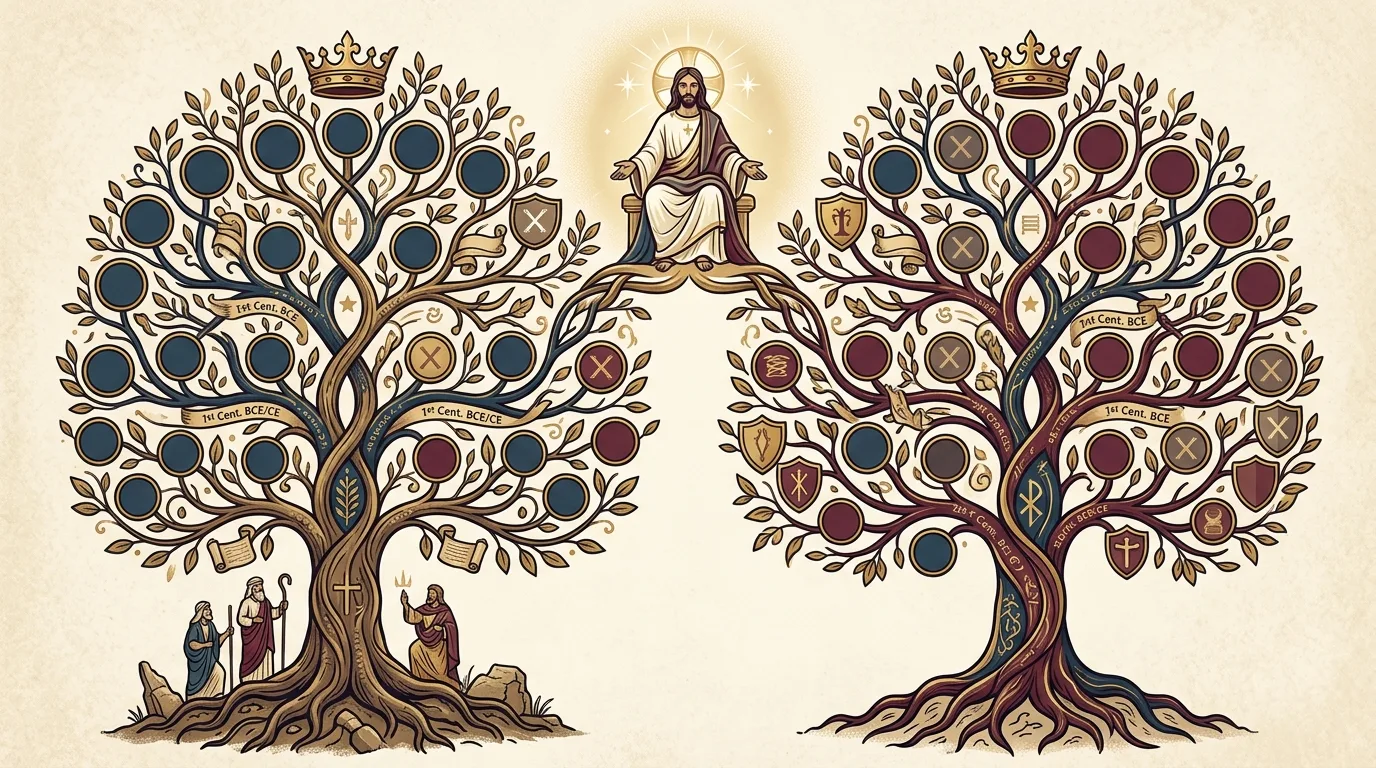
The New Testament opens with a list of names. Most readers skip it, which is a shame, because Matthew 1 is making a claim that can be checked: Jesus of Nazareth descends from King David. Luke makes the same claim in chapter 3 with a list of his own. Put the two lists side by side and they agree on who David was. After David, they barely agree on anything.
Two Lists That Part Ways at David's Sons
Matthew runs forward, from Abraham down to Jesus. Luke runs backward, from Jesus up through Abraham to Adam, and then one step further, to God. From Abraham to David the two lists line up well enough, since both are copying the same Old Testament material.
Then David has sons, and the gospels pick different ones. Matthew follows Solomon, the king, and walks down the royal line of Judah: Rehoboam, Asa, Jehoshaphat, Hezekiah, Josiah. Luke follows Nathan, a son of David who never reigned and who gets almost nothing in the Hebrew Bible beyond his name.
The lists never truly rejoin. Here is how each one ends. Matthew: “And Jacob begat Joseph the husband of Mary, of whom was born Jesus, who is called Christ" (Matthew 1:16, KJV). Luke: “And Jesus himself began to be about thirty years of age, being (as was supposed) the son of Joseph, which was the son of Heli" (Luke 3:23, KJV).
So Joseph has two fathers, Jacob and Heli. Joseph's grandfather is Matthan in one gospel and Matthat in the other.
Forty Names, and the Two That Look Familiar
Count the men Luke places between David and Joseph. There are forty of them: Nathan, Mattatha, Menna, Melea, and on down through Neri, Rhesa, Joanan, Esli, Naggai, Jannai, Levi, and Heli. Matthew fills the same stretch with twenty-five.
Two names appear in both lists: Shealtiel and his son Zerubbabel, the man who led the return from Babylon. At first this looks like a point of contact. It is actually the worst spot in the whole problem.
Matthew makes Shealtiel the son of Jeconiah, the next-to-last king of Judah (1:12). Luke makes him the son of Neri, a man with no royal connection at all (3:27). Then each gospel gives Zerubbabel a different son: Abiud in Matthew, Rhesa in Luke. And the Hebrew Bible's own genealogy of David's house, in 1 Chronicles 3:19, makes Zerubbabel the son of Pedaiah, not Shealtiel, and lists his children without mentioning either Abiud or Rhesa.1Brown works through both lists and rejects reading either as a family record. Fitzmyer, writing on Luke, likewise declines to harmonize them.
So the one place the lists touch, they touch with different fathers above and different sons below. Two men with the same names, joined to two unrelated families. That isn't a meeting point. It's two authors who each knew that a Davidic line ran through Zerubbabel and who each built the rest of it differently.
Matthew Was Counting to Fourteen
Matthew tells you he has a design. “So all the generations from Abraham to David are fourteen generations; and from David until the carrying away into Babylon are fourteen generations; and from the carrying away into Babylon unto Christ are fourteen generations" (1:17, KJV).
The Old Testament lets you check the middle section, and it doesn't come out to fourteen. Matthew 1:8 says “Joram begat Ozias," which is Uzziah. According to 2 Kings 8–15 and 1 Chronicles 3, Joram's son was Ahaziah, whose son was Joash, whose son was Amaziah, whose son was Uzziah. Three kings of Judah are missing, one after another. In 1:11 Matthew makes Josiah the father of Jeconiah, skipping Jehoiakim, who was Josiah's son and Jeconiah's father. Put the missing kings back and the second group runs to eighteen.
The third group has the opposite problem. Count from Shealtiel to Jesus and you get thirteen generations, not fourteen.
Commentators have a good idea why the number mattered. In Hebrew, the consonants of David's name, D-W-D, add up to fourteen. Matthew's structure spells out the name of the king it is trying to prove descent from. Davies and Allison, in the standard critical commentary on Matthew, weigh the gematria seriously as part of the design.2Davies and Allison discuss the fourteen-generation scheme and the likely role of the numerical value of David's name. Nolland's commentary on the Greek text makes the same connection.
That is a lovely piece of theological composition. It is also proof that this genealogy was shaped to hit a number, which means it cannot be treated as a transcript from a family register. Once you know Matthew dropped four kings to make his pattern work, you know which of his priorities came first.
The Oldest Fix: Two Fathers and One Widow
Christians noticed the conflict very early, and the best early answer deserves a fair statement.
Early in the third century, Julius Africanus wrote to a man named Aristides with a solution drawn from levirate marriage, the law in Deuteronomy 25 under which a man whose brother died childless would marry the widow and raise a son in the dead brother's name. Africanus proposed that a woman named Estha married Matthan, of Solomon's line, and bore Jacob. After Matthan died she married Melchi, of Nathan's line, and bore Heli. Jacob and Heli were therefore half-brothers with the same mother and different fathers. Heli died without children, Jacob married his widow, and their son Joseph was Jacob's son by nature and Heli's son by law. Matthew gives the natural line, Luke the legal one, and both are true.
It's clever. It explains how two lists can run in parallel for forty generations and still meet in a single man. Eusebius preserved the letter in his Church History, and it shaped Christian reading for more than a thousand years.3Africanus's letter survives in Eusebius, Church History 1.7. He admits there is no testimony for his account. McGiffert notes that Africanus names Heli's father as Melchi, suggesting his copy of Luke lacked two names.
Here is what it costs. Estha, Matthan's death, the remarriage, and Heli's childless death appear nowhere in scripture. They are the solution, shaped to fit the problem. Africanus said the story came down from Jesus' own relatives, but he conceded the point: “Although we can urge no testimony in its support, we have nothing better or truer to offer." His copy of Luke even named Heli's father Melchi, which suggests it lacked the two generations that stand between them in our manuscripts. The levirate law also concerns brothers of the same paternal house, whose job is to keep a dead man's name alive in his father's line. Half-brothers from two different fathers don't share that line, so the law has no obvious reason to apply. And the whole arrangement only covers Joseph's generation. It does nothing for Shealtiel, who would need a second invented widow to explain his two fathers.
The Newer Fix: Make It Mary's
The explanation most evangelicals learn today is different. Matthew traces Joseph's legal line; Luke, on this view, traces Mary's biological line, with Heli as her father and Joseph as his son-in-law. Darrell Bock's major evangelical commentary on Luke treats it as a serious option. It has an obvious appeal: it gives Jesus real Davidic blood through his mother, which a genealogy of his adoptive father can't do.
The trouble starts with the text. Luke 3:23 names Joseph. Mary does not appear anywhere in the list. The phrase “as was supposed" qualifies whether Jesus is Joseph's son, not whether Joseph is Heli's. Luke elsewhere ties the Davidic claim directly to Joseph, not Mary: Gabriel is sent to a virgin betrothed “to a man whose name was Joseph, of the house of David" (1:27), and Joseph travels to Bethlehem “because he was of the house and lineage of David" (2:4). The only ancestry Luke ever hints at for Mary runs the other way. Her relative Elizabeth (1:36) is “of the daughters of Aaron" (1:5), a priestly family, not a royal one.
The history of the reading is its own evidence. The church fathers treated both lists as Joseph's. Anthony Maas, writing in the Catholic Encyclopedia of 1909, which is not a skeptical source, dates the Mary theory to Annius of Viterbo at the end of the fifteenth century. On his account, no one reading Luke for fourteen hundred years found Mary in it. She was put there when the older fix wore thin.4Maas, writing in the Catholic Encyclopedia, dates the Mary reading of Luke's list to Annius of Viterbo in the late fifteenth century. Ehrman's objection is simpler: Luke traces the line to Joseph through his father, not to Mary through hers.
Both Lists End at a Man Who Isn't the Father
Step back from the harmonizing and a stranger fact comes into view. Matthew and Luke are the only two gospels that tell of a virgin birth. They are also the only two with a genealogy. And both genealogies prove Jesus is David's heir by tracing the ancestry of Joseph, a man both authors go out of their way to say was not his father.
Matthew has to bend his own final line to avoid saying it. For thirty-nine generations the formula is “X begat Y." At the end the pattern breaks: Jacob begat Joseph, the husband of Mary, of whom Jesus was born. Luke inserts his parenthesis for the same reason. Each author is holding a document that says Jesus descends from David through Joseph, and each is also telling a story in which that can't be true in the ordinary sense.
The simplest explanation is that the Davidic lineage and the virgin birth came from different streams of tradition. Paul, writing before any gospel, says Jesus was “made of the seed of David according to the flesh" (Romans 1:3, KJV), and says nothing about a virgin. A community that believed Jesus was Joseph's son needed a genealogy through Joseph. A later community that believed in a virgin birth kept the genealogy anyway, because the Messiah had to be a son of David and it was the only proof they had.
There is also a smaller detail worth noticing. The prophet Jeremiah said of Coniah, the Jeconiah of Matthew's list, “Write ye this man childless, a man that shall not prosper in his days: for no man of his seed shall prosper, sitting upon the throne of David, and ruling any more in Judah" (Jeremiah 22:30, KJV). Matthew ran the Messiah's line straight through him.
If you were taught that these chapters were a verified family record, the fair reading is that they were never meant as one. They were arguments, built by two writers who each knew what the conclusion had to be. You can respect the craft in them. You don't have to believe a woman named Estha married two men to make them agree.