
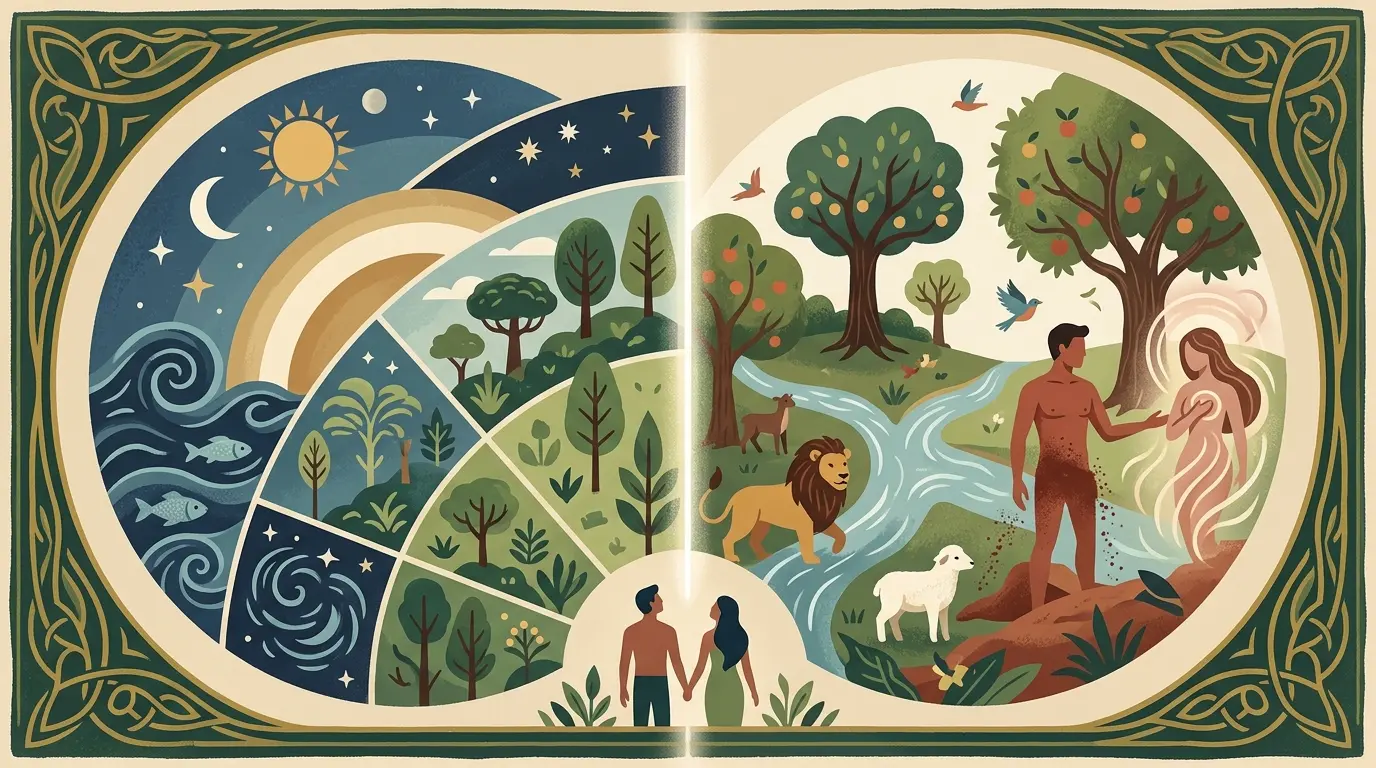
If you grew up in church, you learned the creation story as one story. God made everything in six days and rested on the seventh. He formed Adam from the dust, put him to sleep, took a rib, and made Eve. Maybe it was on a flannelgraph board. Maybe it was in a Sunday school workbook with a cartoon snake. Either way, it came to you as a single, seamless sequence of events.
It isn't one. Genesis contains two creation accounts, placed back to back, and they disagree about what happened and in what order. This isn't a fringe observation cooked up by skeptics. It has been the working assumption of academic biblical scholarship for well over a century, and plenty of believers accept it without blinking. But if you were raised on biblical inerrancy, you probably never heard it, or you heard it only long enough for someone to explain it away. For a lot of people who eventually walked away from Christianity, this is one of the first threads that came loose.
Read Genesis 1 and Genesis 2 Back to Back
The first account runs from Genesis 1:1 through the first half of 2:4. Its order is precise. Light on day one. The sky on day two. Dry land and vegetation on day three. Sun, moon, and stars on day four. Sea creatures and birds on day five. Land animals on day six, and then, as the finale, human beings, created male and female at the same time: “male and female created he them" (Genesis 1:27, KJV).
The second account begins in the middle of 2:4, and it starts over from scratch. The earth is bare. No plant has sprung up yet, “for the LORD God had not caused it to rain upon the earth, and there was not a man to till the ground" (2:5). Then God forms a man from the dust (2:7). Then he plants a garden and makes “every tree" grow (2:8–9). Then he decides the man shouldn't be alone, so he forms animals and birds out of the ground and brings them to the man, looking for a suitable partner (2:18–19). None of them works out. Finally, God puts the man to sleep and builds a woman from his side (2:21–22).
Line the two up and the problems are obvious. In chapter 1, plants exist before humans. In chapter 2, a man exists before any plant has grown. In chapter 1, animals come before humans. In chapter 2, animals are made after the man, specifically as candidates for companionship. In chapter 1, man and woman are created together. In chapter 2, the woman comes last, after God has paraded the entire animal kingdom past Adam and come up empty.
These aren't differences of emphasis. They're differences of sequence, and sequence is exactly what a literal reading depends on.
Even the starting conditions clash. Genesis 1 opens in water, with darkness over the deep, and God has to divide the waters before any land can appear. Genesis 2 opens with dry ground that needs moisture brought up from below before anything can grow. One world begins soaked. The other begins parched.
Two Names for God, Two Different Writers
The accounts don't just disagree on facts. They sound like different people wrote them, because different people did.
Genesis 1 calls God Elohim. This God is distant and majestic. He speaks, and things appear. The chapter moves in tidy, repeating refrains (“and the evening and the morning were the first day") and counts its way to seven. Genesis 2 switches to YHWH Elohim, rendered “the LORD God" in English Bibles. This God works with his hands. He shapes a man out of dirt like a potter, breathes into his nostrils, plants a garden, and in the next chapter goes for a walk in it during the cool of the day (3:8). He tries a solution to the man's loneliness, finds it doesn't work, and tries something else.
Readers noticed this long before the modern era. Baruch Spinoza argued in 1670 that Moses couldn't have written the first five books of the Bible. In 1753, the French physician Jean Astruc proposed that the alternating names for God pointed to separate source documents woven together. By the 1880s, Julius Wellhausen had developed that insight into what's now called the Documentary Hypothesis: the idea that the Torah was assembled from several sources written centuries apart.1The Documentary Hypothesis has a long history. Spinoza's argument against Mosaic authorship appears in chapter 8 of his Theological-Political Treatise (1670). Jean Astruc's 1753 study proposed that Genesis was compiled from separate documents, distinguished partly by their names for God. Julius Wellhausen's Prolegomena to the History of Israel (German 1878 and 1883; English 1885) gave the theory its classic four-source form, usually labeled J, E, D, and P. Since the 1970s, scholars including John Van Seters and Rolf Rendtorff have challenged the idea of a continuous, early J document, and much current European scholarship speaks simply of Priestly and non-Priestly material. The assignment of Genesis 1:1–2:4a to the Priestly source has survived these revisions and remains one of the most widely held conclusions in the field. Richard Elliott Friedman's The Bible with Sources Revealed (2003) prints each proposed source in a different typeface, which makes the seams easy to see.
In that framework, Genesis 1 belongs to the Priestly source, known as P, likely written during or after the Babylonian exile in the sixth century BCE. Genesis 2 comes from older, non-Priestly material traditionally labeled J, for the Yahwist. Wellhausen's details have been revised and argued over for a century and a half. The core observation hasn't budged: the first two chapters of Genesis come from different hands with different concerns. Richard Elliott Friedman's Who Wrote the Bible? (1987) is still the most readable place to start if you want the full case.
The Harmonizing Moves, and Why They Don't Work
If you went to a conservative church or a Bible college, you may have heard the standard fix. Genesis 2 isn't a second creation account, the argument goes. It's a zoomed-in retelling of day six. Chapter 1 is the wide shot, chapter 2 is the close-up.
The trouble is that the close-up still puts events in a different order, so the fix needs help from translators. The ESV and NIV render Genesis 2:19 as God “had formed" the animals, which turns a new act into a flashback. The KJV and NRSV read it straight: God formed them, then brought them to Adam. The Hebrew verb form in that verse normally narrates the next event in a sequence. C. John Collins, a conservative Old Testament scholar, has argued that it can carry a past-perfect sense in certain contexts.2Genesis 2:19 opens with a wayyiqtol verb, the form Biblical Hebrew normally uses to move a narrative forward to its next event. The ESV and NIV translate it as a pluperfect (“had formed"), while the KJV and NRSV translate it as a simple past (“formed"). C. John Collins defended the pluperfect possibility in a 1995 article in the Tyndale Bulletin. Umberto Cassuto, writing from a traditional Jewish perspective, rejected the Documentary Hypothesis altogether and argued that the two divine names reflect different theological meanings rather than different authors. Robert Alter, who accepts that Genesis combines separate sources, argues in The Art of Biblical Narrative that the editor joined them deliberately, in a kind of literary montage, and that ancient readers were comfortable with versions that didn't fully agree. Maybe. But look at the context. In verse 18, God announces that he will make the man a helper. In verse 19, animals are formed and brought to him. Read as a flashback, God proposes a solution he already created days earlier, then marches the animals past Adam anyway. Read in order, it's a perfectly coherent story. It just isn't the story from chapter 1.
The plants get a similar treatment. Apologists often say 2:5 refers only to cultivated crops, not vegetation in general. Even granting that, the second account still has God growing “every tree that is pleasant to the sight" after the man is already standing there.
The strongest defense of the two chapters comes from scholars who don't bother pretending they line up. Robert Alter, whose translation of Genesis is one of the finest in English, reads them as a deliberate literary pairing, two perspectives set side by side on purpose. It's a smart reading. Notice what it concedes, though. An ancient editor knowingly placed two incompatible accounts next to each other. That can be great literature. It can't be a chronology.
Two creation stories can both mean something. They can't both have happened.
“True" Is Doing a Lot of Work
Many Christians already agree that the chapters don't match, and they don't lose sleep over it. They read Genesis as theology, not history. That position is ancient. Origen, writing in the third century, mocked the idea that anyone could take literally a first, second, and third day with no sun, or a God who plants a garden like a farmer.3Origen's comments on the non-literal reading of Genesis appear in Book 4 of On First Principles. The Chicago Statement on Biblical Inerrancy, signed in 1978 at a summit organized by the International Council on Biblical Inerrancy, explicitly denies that inerrancy is limited to spiritual or redemptive themes and extends it to the Bible's claims about history and science (Article XII). Richard Dawkins develops his argument about selective reading of scripture in the chapter of The God Delusion titled “The ‘Good' Book and the Changing Moral Zeitgeist." Bertrand Russell traces the long retreat of theology before scientific findings, including geology and evolution, in Religion and Science (1935).
It's a legitimate way to read an old text. But it gives something up. Once you grant that Genesis 1 and 2 are theological stories rather than records of events, you've concluded that the Bible's opening chapters aren't reliable history. And you reached that conclusion using standards from outside the Bible: geology, biology, and the plain fact that the two chapters contradict each other. Richard Dawkins presses exactly this point in The God Delusion. Believers who don't read scripture literally are choosing which parts to keep, and the criteria they use to choose don't come from scripture. The reader's judgment has quietly replaced the book as the final authority.
Bertrand Russell described the same pattern at the scale of whole centuries in Religion and Science. Every time science settled a question, theology retreated and reinterpreted. Genesis is a textbook case. The six days became long ages, then poetry, then pure theology. The text never changed. What changed was how much believers could still afford to believe.
For anyone raised in a tradition that treats the Bible as error-free, this isn't an abstract debate. The Chicago Statement on Biblical Inerrancy, a foundational document for American evangelicalism, explicitly extends inerrancy to the Bible's claims about history and science. Under that standard, two contradictory sequences in the first two chapters aren't a literary curiosity. They're a problem on page one.
Why This Hits Harder If You Used to Believe
Bart Ehrman, the New Testament scholar who went from evangelical Bible college student to agnostic, tells a story many former Christians will recognize. As a student at Princeton Theological Seminary, he wrote a paper trying to reconcile Mark 2:26, where Jesus says an event happened when Abiathar was high priest, with 1 Samuel, which says it was Ahimelech. His professor wrote back a single suggestion: maybe Mark just got it wrong. Ehrman has said that comment hit him hard, and that once he admitted one error, the rest followed.4Bart Ehrman recounts the Mark 2:26 episode, and his professor's note, in the introduction to Misquoting Jesus (2005). The discrepancy concerns 1 Samuel 21:1–6, which names Ahimelech as the priest. Dan Barker, a former evangelical preacher and Christian songwriter, describes his own gradual deconversion in Godless (2008) and now co-leads the Freedom From Religion Foundation. Sam Harris makes his argument about the Bible's thoroughly human content in Letter to a Christian Nation (2006). Christopher Hitchens's description of religion as a product of humanity's “bawling and fearful infancy" appears in god is not Great (2007).
Genesis 1 and 2 work the same way for a lot of people. One discrepancy doesn't disprove God, and it isn't meant to. What it does is expose the machinery. When you watch the effort it takes to keep two chapters from contradicting each other (the flashback verbs, the crops-only reading, the camera-angle metaphor), you start to wonder why a perfect book needs that much maintenance. Dan Barker, who spent years as an evangelical preacher before becoming one of the country's best-known atheists, describes his own exit in Godless as exactly this kind of slow accumulation. No single blow. Just question after question that the answers stopped covering.
Sam Harris, in Letter to a Christian Nation, challenges believers to find anything in the Bible that people of its own era couldn't have written. The two creation stories pass that test easily. They look like what you'd expect from ancient people working with the knowledge they had, later stitched together by an editor who didn't think the mismatch mattered. Christopher Hitchens put it more bluntly, tracing religion to “the bawling and fearful infancy of our species." You don't have to share his tone to see his point. Nothing in Genesis 1 or 2 knows more than its authors could have known.
If you left the faith and still feel a flicker of guilt reading Genesis this way, you can let it go. You're reading it the way scholars read it, and the way the text practically begs to be read when it sets two incompatible beginnings side by side without apology. The ancient editors weren't embarrassed by the contradiction. The embarrassment came much later, when people decided a collection of ancient writings had to be a single flawless document. Genesis never makes that claim about itself. It just tells you, twice, and differently, how it all began.