
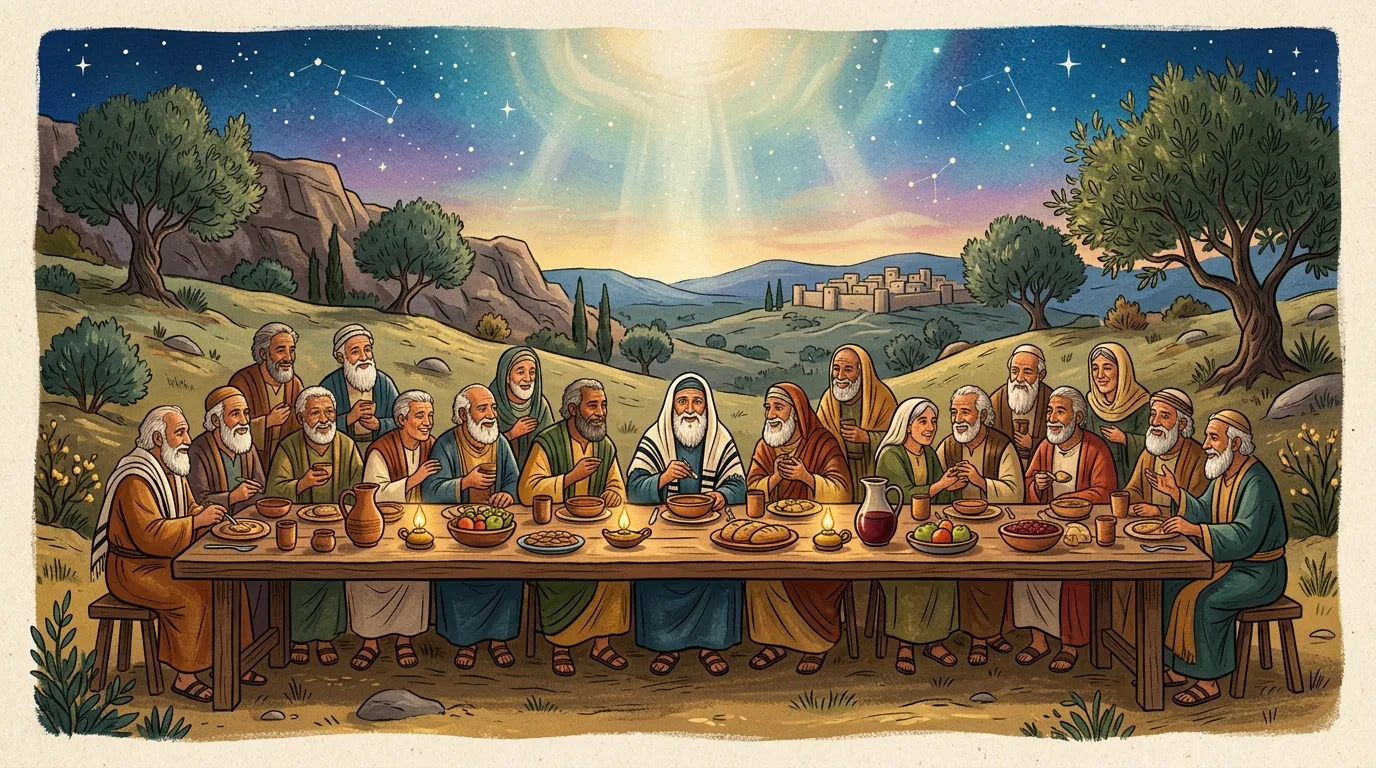
The Gospel of John says it without qualification: “No man hath seen God at any time" (John 1:18, KJV). The First Letter of John repeats the sentence word for word (1 John 4:12). First Timothy goes further and calls God the one “whom no man hath seen, nor can see" (1 Timothy 6:16). Then there's Exodus 24, where seventy-four men climb a mountain, look at the God of Israel, and sit down to eat.
The Guest List and the Menu
The scene comes right after the covenant is sealed in blood at the foot of Sinai. Here is the whole of it:
“Then went up Moses, and Aaron, Nadab, and Abihu, and seventy of the elders of Israel: And they saw the God of Israel: and there was under his feet as it were a paved work of a sapphire stone, and as it were the body of heaven in his clearness. And upon the nobles of the children of Israel he laid not his hand: also they saw God, and did eat and drink" (Exodus 24:9–11, KJV).
There's no dream here, no night vision, no angel standing in for anyone. The text names the guests. It names what they saw, twice, with two different Hebrew verbs for seeing (ra'ah in verse 10, chazah in verse 11). It gives a detail you'd only include if you were picturing a body: God has feet, and the floor under them looks like lapis lazuli and clear sky. Then the elders eat and drink in his presence.
Two of those guests, Nadab and Abihu, would later be consumed by fire from the LORD for offering unauthorized fire (Leviticus 10:1–2). On this day, though, nothing happens to anyone. That's the point of the story.
The Text Expects Them to Die
The most important clause in the passage is the one that's easy to skip: “upon the nobles of the children of Israel he laid not his hand." The author stops to tell you that God didn't strike them down. You don't write that sentence unless your reader expects God to strike them down.
So the author of Exodus 24 knew the rule. Looking at God is dangerous. People who do it die. He tells you the rule was suspended for this one meal, and he does it by having them see God and live. He isn't describing a symbol or a mood. If all they saw was a glow, there would be nothing to survive.
The rule itself shows up nine chapters later. Moses asks to see God's glory, and God answers, “Thou canst not see my face: for there shall no man see me, and live" (Exodus 33:20). God puts Moses in a cleft of the rock, covers him with his hand as he passes, and then removes the hand so Moses can see “my back parts: but my face shall not be seen" (33:23).
Notice that even this restrictive passage is not about an invisible God. It's about a God with a face, a hand, and a back. The danger is in the face. Exodus 33 doesn't say God can't be seen. It says a particular part of him can't be seen safely. Exodus 24 says seventy-four men saw him and nobody died. Those are two different ideas about what happens when a person meets God, and both of them made it into the same book.
Half the Old Testament Saw Him
Exodus 24 isn't an outlier. The Hebrew Bible is full of people who see God and say so.
Jacob wrestles all night with a man at the Jabbok and names the place Peniel, “for I have seen God face to face, and my life is preserved" (Genesis 32:30). Manoah, after watching the angel of the LORD go up in the flame of his altar, tells his wife, “We shall surely die, because we have seen God" (Judges 13:22). Isaiah, in the temple, cries out, “mine eyes have seen the King, the LORD of hosts" (Isaiah 6:5). The prophet Micaiah reports, “I saw the LORD sitting on his throne, and all the host of heaven standing by him" (1 Kings 22:19). Amos says, “I saw the Lord standing upon the altar" (Amos 9:1). And in the same chapter that forbids seeing God's face, the LORD speaks to Moses “face to face, as a man speaketh unto his friend" (Exodus 33:11), while Numbers has God himself say that Moses will “behold the similitude of the LORD" (Numbers 12:8).
Look at the pattern in those reactions. Jacob is surprised his life was spared. Manoah expects to die. Isaiah says “woe is me" before he says what he saw. They all share the assumption of Exodus 24: you can see God, and it might kill you. Not one of them holds the assumption of John 1:18, that nobody has ever seen him at all.
The Bible does have a voice on the other side, and it's Deuteronomy. Recalling Sinai, Moses tells Israel, “ye heard the voice of the words, but saw no similitude; only ye heard a voice" (Deuteronomy 4:12). The point is repeated three verses later as the basis for banning images. Deuteronomy says Israel saw nothing at the mountain. Exodus 24 says Israel's leaders went up the mountain and saw God's feet.
The Translators Flinched First
Long before anyone tried to harmonize these texts, the people translating them were already uneasy. The Greek Septuagint renders verse 10 as “they saw the place where the God of Israel stood," and verse 11 as “they appeared in the place of God, and did eat and drink." The elders no longer see God. They see where he was standing. Targum Onkelos, the standard Aramaic translation read in synagogues, goes another way: they saw “the Glory of the God of Israel," and the eating and drinking becomes rejoicing over sacrifices that were accepted, as though they had eaten and drunk.1The Septuagint has the elders see the place where God stood. Targum Onkelos has them see God's Glory, and turns the meal into joy over accepted sacrifices.
These aren't neutral translations. They're corrections. Both versions keep the shape of the Hebrew sentence and change exactly the words a later reader found unacceptable, which is the same move the Chronicler made when he swapped God for Satan in the census story. Ancient Jewish readers who revered this text could see that it said something about God their own theology couldn't hold, and they adjusted the wording to fit.
“They Saw the Son, Not the Father"
The strongest Christian answer is old. Justin Martyr, writing in the second century, argued that when the Hebrew Bible says God appeared, the one who appeared wasn't the Father. Abraham, Isaac, Jacob, and everyone else saw the Son, who is God, and who carried out the Father's will. The Father, the “ineffable Lord of all," was never seen by anyone.2Justin argues that no patriarch or any other man saw the Father, only the Son, who is God and ministered to the Father's will. Modern evangelicals usually call these appearances theophanies or Christophanies and add a philosophical distinction: the elders saw a form God took on for the occasion, not the divine essence.
This is a serious argument and it has real New Testament support. John's Gospel itself finishes the verse this way: “the only begotten Son, which is in the bosom of the Father, he hath declared him" (John 1:18). Later John says that Isaiah's vision in the temple was a vision of Christ's glory (John 12:41), and Jesus says no one has seen the Father except the one who is from God (John 6:46). If you accept John's framework, there's a way to read Exodus 24 as the Son making an appearance.
The trouble is that it requires reading Exodus through a lens Exodus doesn't have. The author of Exodus 24 doesn't say the elders saw a form, an emissary, or the second person of a Trinity. He says they saw “the God of Israel." To that author, there was no one else to see.
The distinction between form and essence doesn't help either. It's borrowed from Greek philosophy, and neither Exodus 24 nor Exodus 33 knows anything about it. Exodus 33 doesn't forbid seeing God's essence. It forbids seeing his face, and it allows his back. Those are body parts. And if seeing a temporary form doesn't count as seeing God, then John 1:18 isn't saying much. Nobody in the Hebrew Bible ever claimed to see an abstract essence. They claimed to see feet, a throne, a man at the river. The verse only has force if it denies what those people said they saw. Either it denies it, and the texts contradict, or it doesn't, and the verse quietly gives the Old Testament everything it wanted.
The Christophany answer also proves something its defenders don't intend. It concedes that in Exodus 24, someone fully God was visible, had feet, and hosted a meal. That's not a resolution of the tension. It's an admission that Exodus describes an embodied God, combined with a later theology that relocates the body to a different person of the Godhead.
The God of Israel Used to Have a Body
Biblical scholars have a simpler explanation, and it doesn't involve harmonizing anything. Israel's idea of God changed over time, and the Bible preserves different stages of that change side by side.
Benjamin Sommer of the Jewish Theological Seminary argues that some of the oldest material in the Torah thinks of God as having a body, and even more than one body, able to appear in different places at once. The Priestly and Deuteronomic writers rejected that idea and replaced it with something more controlled. For the Priestly writers, God's presence is the kavod, the glory, a single blazing body located in the sanctuary. For Deuteronomy, God himself is in heaven and only his name dwells in the temple.3Sommer argues that older biblical traditions imagined a God with multiple bodies, and that the Priestly and Deuteronomic schools rejected that idea. Deuteronomy's insistence that Israel saw no form at Sinai reads like an argument with the tradition behind Exodus 24.
Esther Hamori's study of God's appearances in Genesis 18 and 32 makes a similar case from a different angle: the narrators of those chapters present God showing up as a man, eating with Abraham and wrestling with Jacob, and they mean it concretely. Francesca Stavrakopoulou's God: An Anatomy traces the same picture across the whole Hebrew Bible, from God's feet to his face, and argues that the bodiless God of later Judaism and Christianity is the product of the theology that came after these texts were written.4Hamori reads Genesis 18 and 32 as God appearing in concrete human form. Stavrakopoulou argues the biblical God was once imagined with a full human body.
On this view, Exodus 24 isn't a problem to be solved. It's evidence of what Israel once believed. John 1:18 is evidence of what Jews and early Christians believed centuries later, after a long encounter with Greek philosophy had taught them to think of God as invisible by nature. The two verses don't disagree because one of them is misunderstood. They disagree because they were written by people who believed different things about God.
The elders on the mountain weren't seeing a metaphor. They were seeing the only God their tradition knew how to imagine.
If you were taught that the Bible's picture of God is consistent from Genesis to Revelation, Exodus 24 is a good place to test that claim, because it's short and it's clear. Read it without Justin, without the Septuagint, and without a commentary telling you what it can't mean. Seventy-four men looked at God and ate lunch. The author of that story believed it happened and believed it was safe. The author of John believed it never happened to anyone. You don't have to decide which of them was inspired. You only have to notice that they can't both be telling you the truth about the same God.