
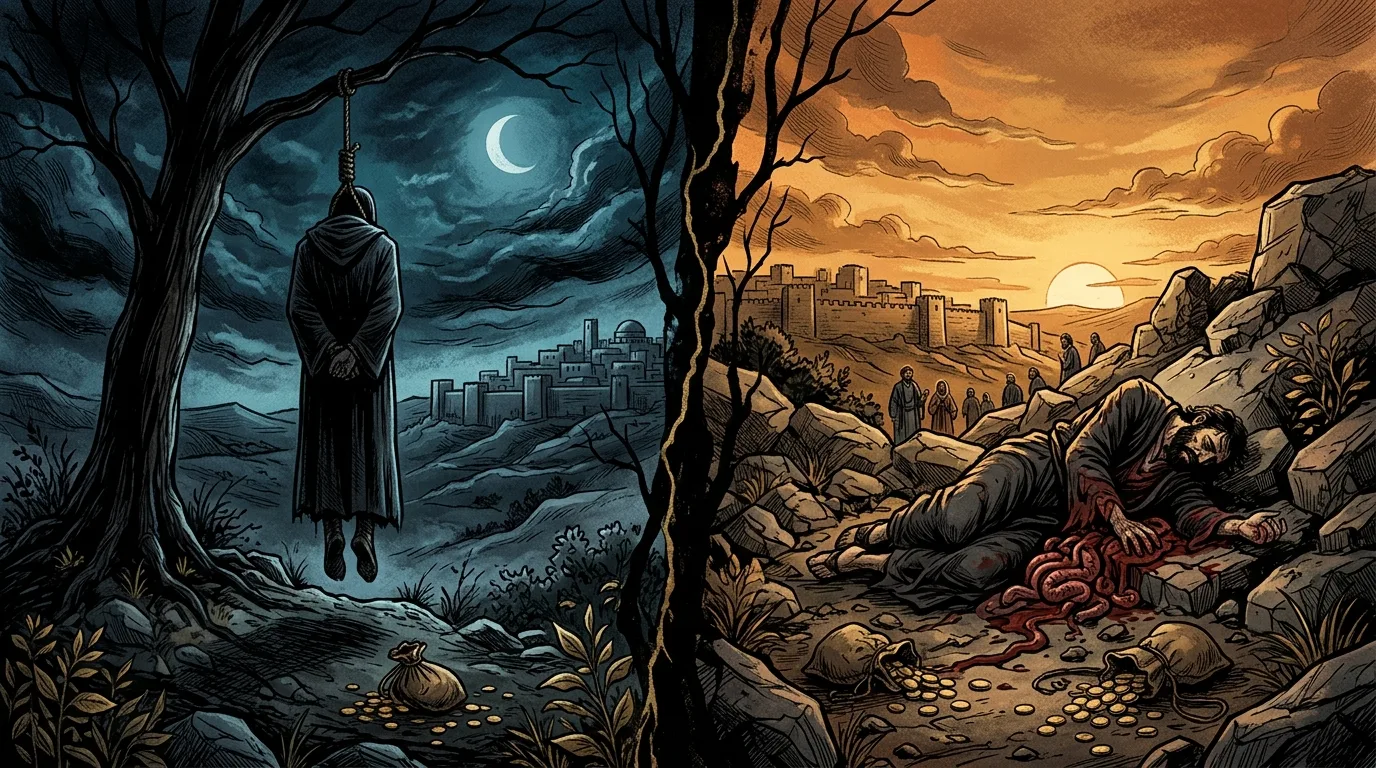
Judas Iscariot dies twice in the New Testament. In Matthew he throws his silver on the temple floor and hangs himself. In the Acts of the Apostles he buys a field with that silver and his body splits open in it. The two stories share a villain and a place called the Field of Blood. Nearly everything else in them disagrees.
In Matthew, Judas Gives the Money Back
Matthew's account comes the morning after the arrest, when the chief priests and elders have decided to hand Jesus over to Pilate. Judas sees that Jesus is condemned, and something in him turns. “Then Judas, which had betrayed him, when he saw that he was condemned, repented himself, and brought again the thirty pieces of silver to the chief priests and elders, Saying, I have sinned in that I have betrayed the innocent blood" (Matthew 27:3–4, KJV).
The priests brush him off. He throws the silver down in the temple, leaves, and “went and hanged himself" (27:5). That's all Matthew says about the death itself. Half a verse.
The rest of the passage is about the money. The priests won't put it back in the treasury, “because it is the price of blood." So they use it to buy the potter's field as a burial ground for foreigners. “Wherefore that field was called, The field of blood, unto this day" (27:6–8). The blood in the name is Jesus' blood. The field carries it because the priests paid for the land with the price of his life.
In Acts, Judas Keeps It
Acts opens with the eleven remaining apostles in Jerusalem, needing a twelfth. Peter stands up to explain the vacancy, and in the middle of his speech the author of Luke and Acts gives his own account of what happened to Judas:
“Now this man purchased a field with the reward of iniquity; and falling headlong, he burst asunder in the midst, and all his bowels gushed out. And it was known unto all the dwellers at Jerusalem; insomuch as that field is called in their proper tongue, Aceldama, that is to say, The field of blood" (Acts 1:18–19, KJV).
Read that as a story, the way you'd read Matthew's. Judas buys the field himself. There's no remorse and no returned money; the silver is “the reward of iniquity," and he spends it on land. He dies from a fall, not a rope. And the field gets its name because the whole city heard how he died there. The blood in this name is his own.
Peter then supplies the scripture it fulfills: “Let his habitation be desolate, and let no man dwell therein" (1:20, quoting Psalm 69:25). The curse lands on a man's dwelling. In Acts the field is Judas's property, and the psalm only fits if it is.
The NRSV and several other modern translations print verses 18 and 19 in parentheses, because they can't really be Peter's words. He's speaking to Jerusalemites, in their own language, and wouldn't need to tell them what they call the field “in their proper tongue." That aside is the author talking to his Greek readers. It's Luke, not Peter, who is telling you how Judas died.
The Disagreement Isn't Only About the Rope
People usually frame this as a question about cause of death, hanging or falling. That's the easiest difference to explain away and the least important one. Set the two accounts side by side and there are more questions to answer.
Who bought the field? Matthew says the priests did, after Judas was dead. Acts says Judas did. Why is it called the Field of Blood? Matthew says it was bought with blood money. Acts says Judas bled out on it. Did Judas repent? Matthew says he confessed and tried to undo what he'd done. Acts shows no sign of it and calls the money his wages. Where did the silver end up? In Matthew it goes back to the priests. In Acts it becomes real estate.
Bart Ehrman puts the naming question at the center, and he's right to. A harmonizer can splice two causes of death together. It's much harder to splice two explanations of one place name when each is offered as the reason for it.1Ehrman uses Judas's death as a test case for the gospels' discrepancies and presses the question of why the field got its name.
The Rope Broke, and Then What?
The standard defense runs like this. Judas hanged himself, as Matthew says. At some point the rope or the branch gave way, and the body fell and ruptured, as Acts says. Matthew tells you how he killed himself; Luke tells you what was found. As for the purchase, the priests bought the field with Judas's money, so in a legal sense it was his. Every statement in both texts comes out true.
Gleason Archer's Encyclopedia of Bible Difficulties, a standard evangelical reference on these problems since 1982, gives the most detailed version. The tree, Archer proposes, overhung a precipice. The branch was dead and dry, and a strong gust of wind split it and plunged the corpse into the chasm below. The wind comes from the crucifixion: the temple curtain tore, the earth shook, and the darkness was followed, Archer writes, “undoubtedly also by a thunderstorm."2Archer's harmonization places the tree over a precipice and has a gust at the hour of Jesus' death bring the body down. He reads Peter's “purchased a field" as irony: the plot Judas acquired was his grave.
This deserves a fair hearing, because it's what most people who defend the text actually believe. So look at what it requires. Matthew never mentions wind. He mentions a torn curtain, an earthquake, and split rocks (27:51), and Archer turns those into weather. Matthew also places the suicide in the morning, before Jesus has even reached Pilate (27:1–5), so the corpse has to hang for hours and then drop at the ninth hour. The cliff, the dead branch, and the gust are in neither text. They are the harmonization.
And the field is still there. Archer takes “purchased a field" as irony: Judas got his real estate, all right, and it was a burial plot. That handles the verb. It doesn't handle Acts 1:19, which says the field got its name because Jerusalem heard about the death, and it doesn't handle the psalm, which calls the place his habitation. Matthew and Acts each tell you why the field is called what it's called. Only one of those can be the reason.
The Oldest Fix Made It Worse
Christians noticed early. One of the oldest surviving treatments involves Papias, a bishop in Asia Minor in the early second century, whose five books are lost except for quotations in later writers. One of those quotations, preserved by the fourth-century writer Apollinaris of Laodicea, describes how Judas ended.
It's grotesque, and nothing in it involves a rope. Judas swells until he “was unable to pass through a place where a wagon passes easily." His eyelids swell until he can't see the light. His genitals are disfigured, and he passes pus and worms. He finally dies “in his own place," and the land reeks so badly that “to this day no one can pass that place unless they hold their nose." Candida Moss reads the passage against the ancient stock death of tyrants and the greedy: Antiochus IV swarming with worms in 2 Maccabees, Herod the Great rotting in Josephus, Herod Agrippa “eaten of worms" in Acts 12:23.3The Papias fragment survives only in catenae attributed to Apollinaris of Laodicea. Quotations follow Ehrman's Loeb translation as cited by Moss. Zwiep prints and compares the catena texts.
Look at what Papias is doing with Acts. “His own place" is Acts 1:25, where Judas goes “to his own place." The deserted, stinking ground is the desolate habitation of Acts 1:20. The swelling is one possible reading of the Greek word Acts uses for how he fell, prēnēs, which the NRSV's margin renders “swelling up." Papias was elaborating Acts. Nothing in his account needs Matthew.
Apollinaris saw the gap and closed it. He introduced the Papias passage with his own claim that Judas didn't die by hanging at all: he was cut down before he choked, and lived on. That is the rope-broke defense already at work in the fourth century, and look at its price. To keep both texts, Apollinaris had to say that Matthew's hanging didn't kill anyone. Another version in the same catena tradition has the swollen Judas crushed by a wagon. Arie Zwiep, whose monograph on Acts 1 surveys these legends, observes that by the testimony of Christian and Jewish tradition Judas “must have died a great many deaths and yet he seems to have survived as many times as that."
Matthew Built His Scene From Scripture
If the two accounts can't be merged, the next question is where each one came from. Matthew answers part of it himself. “Then was fulfilled that which was spoken by Jeremy the prophet, saying, And they took the thirty pieces of silver, the price of him that was valued, whom they of the children of Israel did value; And gave them for the potter's field, as the Lord appointed me" (27:9–10, KJV).
That isn't Jeremiah. The thirty pieces of silver and the potter come from Zechariah: “So they weighed for my price thirty pieces of silver. And the LORD said unto me, Cast it unto the potter… And I took the thirty pieces of silver, and cast them to the potter in the house of the LORD" (Zechariah 11:12–13, KJV). Jeremiah does go down to a potter's house (Jeremiah 18), then carries a potter's jar into the valley of Hinnom and announces that it will be renamed “The valley of slaughter" (19:6), and later buys a field for seventeen shekels (32:9). Tradition puts Akeldama in that same valley. Matthew seems to have fused the two prophets.
The defenses are familiar: Matthew named the more prominent prophet, or a copyist slipped, or Jeremiah said it in a lost book. None of them changes what the verse shows about method. Matthew started with prophecy and wrote a scene in which each piece appears. Judas casts the silver into the temple because Zechariah cast it into the house of the Lord. The priests buy a potter's field because the prophecy had a potter in it.4Brown gives Matthew's Judas scene its own section in his commentary on the passion narratives, with a separate appendix on Judas. The quotation in Matthew 27:9–10 matches Zechariah, not Jeremiah.
The hanging has a model too. Only one man in the Hebrew Bible hangs himself: Ahithophel, David's trusted counselor, who went over to Absalom's revolt. When his advice was rejected, he “gat him home to his house, to his city, and put his household in order, and hanged himself, and died" (2 Samuel 17:23, KJV). A friend of the king betrays him and ends on a rope. Matthew didn't need an eyewitness to know how a traitor to the Son of David should die.
Acts draws on different models: the psalms Peter quotes, the desolate habitation, the office another man takes. Its Judas dies the way the wicked die in the literature Moss surveys, with his insides spilling out. Each author gave Judas the ending his sources said a traitor deserved. The sources were different, so the endings are too.
What the Two Stories Actually Share
Take away what each author drew from scripture and very little is left. Judas died not long after the crucifixion, and a plot of land near Jerusalem was called the Field of Blood and tied to his name. That much may be historical. Every detail of how he died and how the field got its name was supplied later, twice, by two writers who either didn't know the other's version or didn't care about it.
If you were taught that the rope broke, notice where that answer comes from. Nobody reading Matthew alone would think of it, and nobody reading Acts alone would either. It exists only because the two had to be made to agree, and one of the oldest versions on record begins by admitting that Matthew's hanging didn't kill him. Archer's cliff and gust of wind are the same move with more scenery. You're allowed to let the stories be two. Judas died twice because two writers each told it the way scripture said it should go, and neither of them was there.