
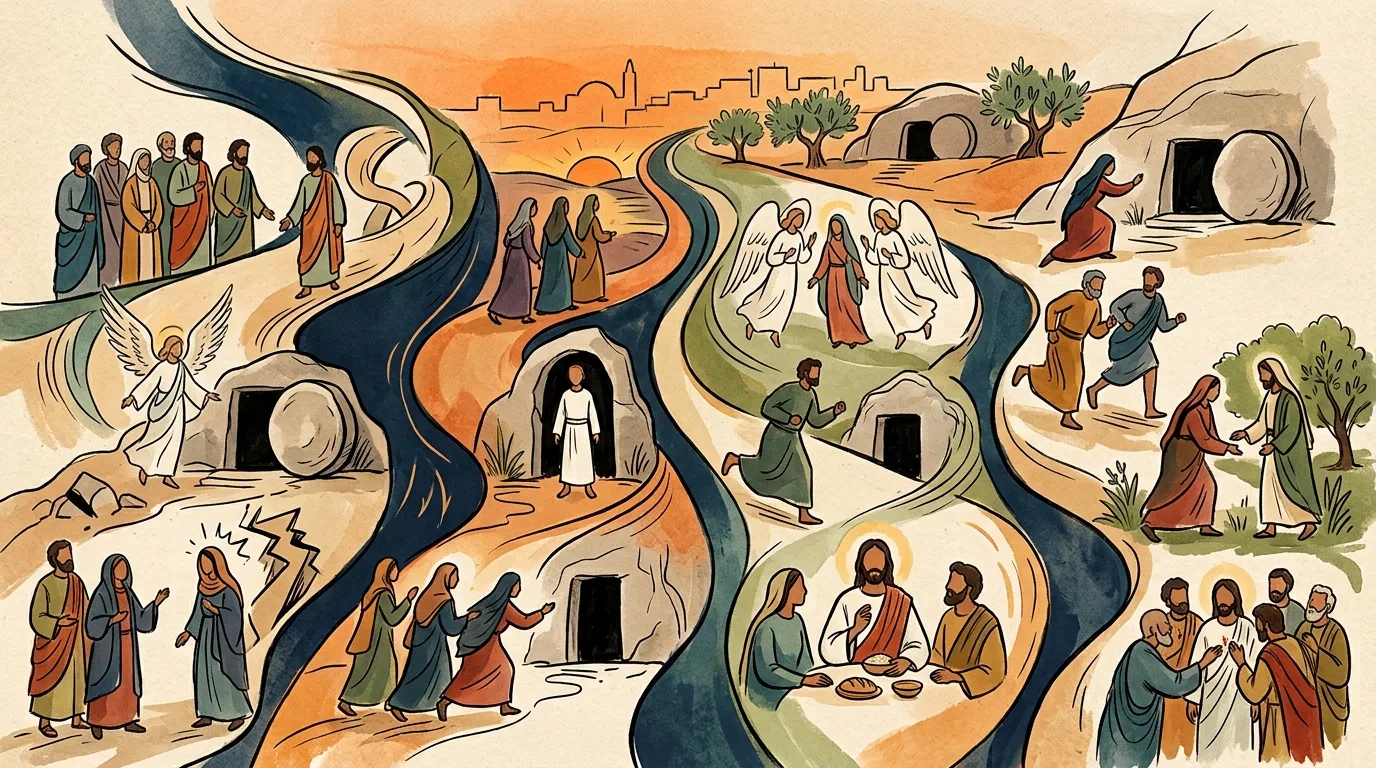
Every Easter sermon tells one story. The women come to the tomb at dawn, find the stone rolled away, hear an angel, run to tell the disciples, and then Jesus appears. That story is a composite. No gospel tells it that way, because the four gospels, and Paul writing before any of them, tell versions that can't be laid on top of each other without something giving way.
These aren't the differences you'd expect from four people noticing different things. They concern who was there, what the women did next, and which city the risen Jesus appeared in.
Who Went to the Tomb, and When
Mark, the earliest gospel, sends three women: “Mary Magdalene, and Mary the mother of James, and Salome" (Mark 16:1, KJV). They arrive “very early in the morning the first day of the week… at the rising of the sun" (16:2). The NRSV makes the timing plainer: “when the sun had risen."
Matthew drops Salome. It's “Mary Magdalene and the other Mary," and they come “as it began to dawn" (Matthew 28:1). Luke names Mary Magdalene, Joanna, and Mary the mother of James, then adds “other women that were with them" (Luke 24:10). John sends Mary Magdalene alone, “when it was yet dark" (John 20:1).
The usual answer is that no gospel says only these women went. John focuses on Mary, and she even reports “we know not where they have laid him" (20:2), which suggests company. That's a fair point about the head count, and it's the strongest card the harmonizer holds in this story. It buys less than it seems to. John's Mary sees the stone moved and runs off before anyone has told her anything. The women in the other three gospels stay to hear an angel explain it. Whoever Mary was with, she didn't have their morning.
One Angel, a Young Man, or Two Men
In Mark the stone is already rolled back when the women arrive. They go inside and see “a young man sitting on the right side, clothed in a long white garment" (16:5). One figure, inside, seated.
Matthew stages a spectacle. “And, behold, there was a great earthquake: for the angel of the Lord descended from heaven, and came and rolled back the stone from the door, and sat upon it" (28:2). The guards, whom only Matthew posts at the tomb, become “as dead men" (28:4). Then the angel speaks to the women (28:5). One figure, outside, and the women seem to arrive in time to see him move the stone.
Luke has “two men… in shining garments," and they're standing (24:4). John has no one at all on Mary's first visit. Only after Peter and the other disciple have come and gone does she look in and see “two angels in white sitting, the one at the head, and the other at the feet, where the body of Jesus had lain" (20:12).
Harmonizers have moves here, and each works by itself. Mark's young man is an angel in human form. Mark and Matthew mention only the angel who spoke. Angels who sit can stand. On the stone, the reply is that Matthew's earthquake happened before the women got there and is told out of order. The Greek doesn't forbid that, but nothing in it points that way. Matthew goes straight from the women setting out to the earthquake, and the angel addresses them from his seat on the stone. In the other three gospels, nobody they saw moved it.
Mark Ends in Silence
The angel gives the same instruction in Mark and Matthew: tell the disciples that Jesus is going ahead of them to Galilee, and they'll see him there (Mark 16:7; Matthew 28:7). What happens next splits the gospels in two.
In Matthew the women leave “with fear and great joy; and did run to bring his disciples word" (28:8). Jesus meets them on the way, and they take hold of his feet. In Luke they return and tell “all these things unto the eleven, and to all the rest," who dismiss it as “idle tales" (24:9, 11).
Mark says the opposite. “And they went out quickly, and fled from the sepulchre; for they trembled and were amazed: neither said they any thing to any man; for they were afraid" (16:8, KJV). Codex Sinaiticus and Codex Vaticanus, the two great fourth-century copies of the Greek Bible, end Mark right there. The twelve verses most Bibles print after it, with appearances to Mary Magdalene, to two travelers, and to the eleven, were added later and borrow from the other gospels. Bruce Metzger's commentary on the text of the New Testament, the standard reference for these decisions, treats them as not part of what Mark wrote.1Sinaiticus and Vaticanus end Mark at 16:8. Metzger's commentary judges the longer ending (16:9–20) secondary on both manuscript and internal evidence.
So the earliest account of the empty tomb has no appearance of the risen Jesus, and it ends with the only witnesses telling no one. Apologists read “said nothing to anyone" as temporary: the women kept quiet on the road, then told the disciples. That isn't what the sentence says, and it isn't how Matthew read it. Matthew kept Mark's fear, added “great joy," and turned the flight into a run to the disciples. He was revising an ending he couldn't accept. Here you can watch one evangelist correct another.
Galilee or Jerusalem
This is the disagreement the harmonies handle worst. Mark points to Galilee and stops. Matthew follows through. The women meet Jesus near the tomb, but the eleven see him only once, on a mountain in Galilee, where he sends them to make disciples of all nations (28:16–20). Matthew records no appearance to the disciples in Jerusalem. The angel's message, and Jesus' own on the road (28:10), is to leave the city.
Luke rewrites the angel. Mark's “he goeth before you into Galilee" becomes “remember how he spake unto you when he was yet in Galilee" (24:6). Galilee is now a memory, not a destination. That same day Jesus walks with two followers to Emmaus, appears to the eleven in Jerusalem that night, and tells them, “tarry ye in the city of Jerusalem, until ye be endued with power from on high" (24:49). In Acts, by the same author, he “commanded them that they should not depart from Jerusalem" (Acts 1:4). Luke's disciples never go to Galilee at all.
Luke also disagrees with himself about how long this lasted. The gospel reads naturally as a single day: tomb at dawn, Emmaus in the afternoon, Jerusalem at night, then out to Bethany, where Jesus “was parted from them, and carried up into heaven" (Luke 24:51). Acts opens with Jesus appearing to them over “forty days" before he ascends (Acts 1:3).
John tries to have both. The disciples see Jesus in a locked room in Jerusalem that evening (20:19), and again a week later with Thomas (20:26). Then chapter 21, which follows what reads as the book's closing statement (20:30–31), moves to the Sea of Tiberias in Galilee, where seven of them have gone back to fishing and don't recognize Jesus on the shore.
Raymond Brown, a Catholic priest who wrote the Anchor Bible commentary on John, considered the obvious fix, Jerusalem appearances first and Galilee afterward, and rejected it. The Galilee stories, he observed, read as if the disciples are seeing the risen Jesus for the first time.2Brown rejects harmonizing the appearances into a Jerusalem-then-Galilee sequence, because the Galilean accounts seem to exclude prior appearances to the Twelve. Ehrman makes the same Galilee-or-Jerusalem argument for a popular audience. He's right. Matthew's eleven still include doubters on the mountain (28:17). John's fishermen don't know who is talking to them, a week after Thomas was invited to put his hand in the wound.
The Best Harmonies, and Where They Break
The most serious attempt to put all of this together is John Wenham's Easter Enigma, from 1984. Wenham reconstructs where everyone spent the weekend. Peter, John, and Jesus' mother stay at John's house in Jerusalem. Joanna and Susanna lodge in the Hasmonean palace. Mary Magdalene, the other Mary, and Clopas go out to Bethany on Saturday night. The women set out for the tomb from different houses, in different groups, which is how one gospel can have them arriving in the dark and another in sunlight.
It's ingenious, and it's open about its method. Wenham assumes from the start that the evangelists were well informed and that one gospel can fill gaps in another. None of the lodgings appear in any gospel. Mary Magdalene becomes Mary of Bethany, an identification no gospel makes. The staggered arrivals exist so that each text can be describing a different party. And none of it touches Galilee. No arrangement of houses in Jerusalem changes the fact that Matthew sends the disciples north and Luke forbids them to leave.
Michael Licona, an evangelical New Testament scholar, takes a different route. In Why Are There Differences in the Gospels? he compares the gospels to Plutarch, who told the same events differently in different biographies, and argues that the evangelists used the conventions of ancient biography: simplifying a scene, giving one speaker's words to another, moving an event in time. That's an advance over Wenham, because it admits the differences are real. It's also a concession. If Luke folded forty days of appearances into one evening, then one of his two accounts doesn't describe what happened, and a reader has to ask which details in any gospel have been moved. Licona knows what candor costs. When he suggested in 2010 that the dead saints rising at the crucifixion (Matthew 27:52–53) might be apocalyptic imagery rather than history, the backlash ended with his departure from the Southern Baptists' North American Mission Board.3Wenham reconstructs lodgings and movements for every party on Easter weekend. Licona explains gospel differences through the compositional conventions he finds in Plutarch's Lives.
Paul, Writing First, Knows None of It
Paul wrote 1 Corinthians in the 50s, before Mark, and passes on a tradition he says he received: Jesus “was seen of Cephas, then of the twelve: After that, he was seen of above five hundred brethren at once… After that, he was seen of James; then of all the apostles. And last of all he was seen of me also" (1 Corinthians 15:5–8, KJV).
There are no women. There's no visit to the tomb and no angel, though Paul does say Jesus was buried (15:4). Peter comes first, where Matthew and John give the first appearance to Mary Magdalene. Jesus appears to the twelve, though by every gospel's count there were eleven. No gospel mentions the five hundred, a strange omission for four biographers if they knew of it. James is the brother whose family, in the gospels, doesn't believe in Jesus (John 7:5). And Paul puts his own vision, years later, in the same list with the same verb, as if he saw what the others saw.
Ask for One Story
Dan Barker, a former evangelical preacher, turned all of this into a simple request. “My challenge is simply this: tell me what happened on Easter. I am not asking for proof." Read the end of each gospel, Acts 1, and 1 Corinthians 15, he says, then write one chronological account from the resurrection to the ascension. Guess at times if you need to. Just don't leave out a single detail.4Barker's challenge allows educated guesses about timing and parenthetical explanations. The one condition is that no biblical detail may be omitted.
The best reply to Barker is that no ancient event could pass his test. Tell me exactly what happened the day Rome was founded. That's fair, for Rome. Nobody claims Livy was inspired, and nobody's salvation depends on Romulus. And the problem with Easter isn't that details are missing. It's that the details we have point in different directions.
If you grew up with the composite story, it's worth knowing that none of the evangelists wrote it. Each told the resurrection the way his community needed it told. Mark's Jesus goes ahead to Galilee and the book stops at the edge of fear. Matthew's commissions his followers from a mountain. Luke's keeps them in Jerusalem, because Acts will spread the church outward from that city. What you can't do is treat four theological choices as four eyewitness reports and expect them to agree. They don't, and you're allowed to stop pretending they do.